SAA-Partner Universities Forum Highlights Expansion of Agricultural Training in Ethiopia
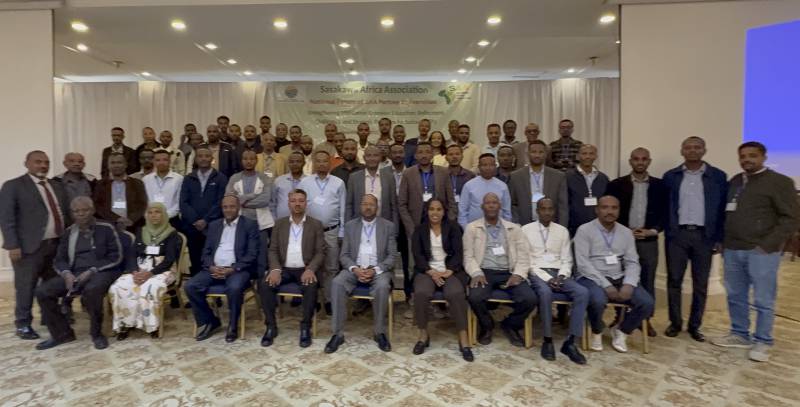
The Sasakawa Africa Association (SAA) Ethiopia convened a National University Forum on November 13, 2025, at the Getfam Hotel in Addis Ababa, bringing together 65 representatives from government ministries, regional bureaus, civil service institutions, and ten partner universities. The forum focused on launching new curricula, reviewing the mid-career training program, and addressing sustainability challenges in agricultural education.
Organized under the theme “Strengthening Mid-Career Extension Education: Reflections, Challenges, and Strategic Pathways for Sustainability”, the event opened with remarks from Dr. Ermias Abate, Deputy Country Director of SAA-Ethiopia, followed by strategic updates from Country Director Dr. Fentahun Mengistu. Dr. Tesfaye Worku, Capacity Building Technical Coordinator, presented progress on the mid-career training program currently underway across partner universities.

Dr. Ermias Abate, Deputy Country Director, SAA-Ethiopia addressing at the Forum
Responding to employer demand, SAA and its partner universities in Ethiopia’s Amhara Region unveiled four new blended extension curricula in Natural Resource Management, Crop Science, Livestock, and Horticulture. Developed through a consultative process, these programs aim to align with regional and national priorities and accelerate agricultural transformation. The curricula, supported by 60 specialized training modules, have been launched at Bahir Dar, Gondar, and Wollo Universities and are now being adopted by three Agricultural Technical and Vocational Education and Training (ATVET) colleges— Kombolcha, Woreta, and Merto Lemariam.
A major milestone celebrated at the forum was the enrollment of 1,425 Development Agents (DAs) into these programs at the same universities. Notably, women accounted for 57 percent of the intake, marking a significant step toward gender equity in agricultural education. Plans are also underway to admit additional 1,483 students at ATVET colleges.
Speakers underscored the urgency of upgrading extension agents’ qualifications. Mr. Kegnazmach Mesfin, Director of Extension of the Amhara Region noted that 65 percent of the region’s DAs currently hold only diploma-level qualifications and emphasized the need to elevate them to bachelor’s degree level through the new mid-career curricula.
Participants applauded the expansion of SAA’s capacity-building program and its contribution to national agricultural development. Since its launch at Haramaya University in 1997, the program has expanded to 11 universities, producing 2,344 graduates and enrolling 2,130 more. Although SAA has exited from some universities, many programs remain sustainable, with current support focused on technical backstopping and ongoing training. Participating universities commended the e-learning platform developed by SAA, recognizing it as a key enabler in expanding program delivery.
Forum sessions featured institutional reports highlighting achievements, challenges, and future plans. Discussions emphasized the importance of Supervised Enterprise Projects (SEPs) and acknowledged that budget limitations remain a major constraint. Several universities reported inconsistent support from employers for students conducting SEPs, particularly regarding financial assistance.

From L-R: Dr. Kassahun Tegegne, Vice President, University of Gondar, Dr. Fentahun Mengistu, Country Director, SAA-Ethiopia, Dr. Birhan Asmamie, Vice President, Wollo University facilitating discussion
To address these challenges, participants recommended diversifying funding sources and strengthening employer engagement in the planning, implementation, and evaluation of SEPs. In line with this recommendation, stakeholders committed to drafting a joint proposal aimed at pursuing sustainable funding opportunities for SEP initiatives. Universities also agreed to harmonize curricula nationally in line with Ministry of Education requirements and establishing a committee to oversee the process.
The forum reaffirmed SAA’s role in strengthening Ethiopia’s agricultural capacity building efforts, aligning closely with the country’s Ethiopian Education Development Roadmap (2018-2030), and Agricultural and Rural Development Policy, which envisions national prosperity by 2040.
SAA Publications
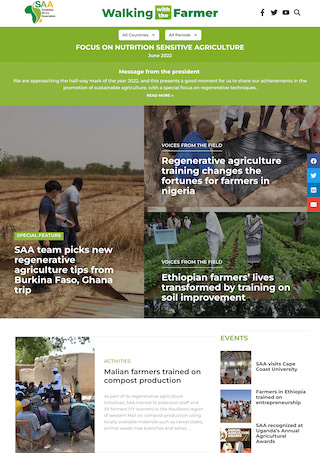
E-newsletter
"Walking with the Farmer"
SAA publishes a bimonthly e-newsletter reporting on SAA activities.
SAA Mail News
Sign up to receive our e-newsletter and upcoming event information via email.

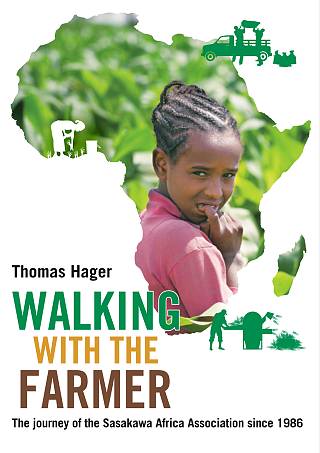
SAA history book
"Walking with the Farmer: The journey of the Sasakawa Africa Assoication since 1986"
This book chronicles the history of SAA from its inception to the present.
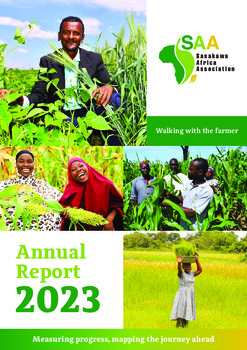
Annual Report
Annual Report FY2023
Annual Report FY2023 is available here.


