SAA-Developed Cassava Agroforestry Curriculum Adopted by 22 Nigerian Universities
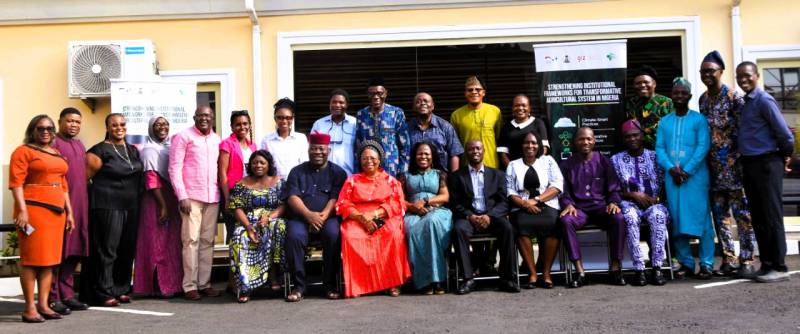
Twenty-two universities and colleges of agriculture in Nigeria have taken a significant step toward reforming agricultural extension education with the review and validation of a new Cassava Agroforestry Curriculum developed by Sasakawa Africa Association (SAA) Nigeria under the Strengthening Institutional Frameworks for Transformative Agricultural Systems in Nigeria (SIFTAS) project, funded by Deutsche Gesellschaft für Internationale Zusammenarbeit (GIZ). The initiative strategically positions cassava agroforestry as a formal component of agricultural education strengthening the capacity of students and extension practitioners to address challenges such as climate change, land degradation, and low productivity in cassava-based systems.
Curriculum Validation Workshop in Ibadan
The validation workshop, held on 11–12 February 2026 in Ibadan, Oyo state, convened seasoned academics and researchers from 13 universities and 9 colleges of agriculture, and the International Institute of Tropical Agriculture (IITA). Participants conducted a detailed review of the new curriculum to ensure alignment with national academic and competency standards, institutional requirements, and local agroecological realities. With the validation completed, several participating institutions are preparing to mainstream the cassava agroforestry curriculum into their existing programs for delivery in the forthcoming academic session as part of the pilot implementation phase.
Addressing Emerging Challenges in Cassava Production
Cassava remains central to Nigeria’s food security and rural livelihoods, yet current production systems and training models are not fully keeping pace with emerging challenges such as climate change, land degradation, and the shift toward climate-smart and regenerative agriculture. While discussions on carbon markets are increasing, opportunities for carbon credit remain largely inaccessible for most smallholder farming systems. At the same time, many agricultural graduates and extension workers still have limited exposure to integrated and climate-resilient production practices, which slows the adoption of sustainable innovations at the farm level. SAA’s intervention seeks to address this gap by enhancing capacity building anchored in practical extension experience. The Cassava Agroforestry Curriculum is part of SAA’s broader strategy to enhance the skills of front-line and mid-career extension workers, students, smallholder farmers, farmer organizations, and other value-chain actors. Beyond field-level training, SAA partners with 31 universities and agricultural colleges across Africa to deliver demand-based programs that equip extension systems with relevant, practice-oriented knowledge.
Institutionalizing Agricultural Innovation
Speaking at the workshop, Dr. Bidemi Ajibola, SIFTAS Project Coordinator, emphasized the importance of embedding agricultural innovations within formal education systems. “For transformation to be sustainable, it must be institutionalized,” Dr. Ajibola said. “By mainstreaming the cassava agroforestry curriculum into university and college programs through the SIFTAS project, we are strengthening the capacity of extension agents and graduates before they enter the field. This ensures that farmers receive guidance rooted in climate-smart, productive, and market-responsive practices”
The curriculum forms a core component of SIFTAS’s transformative agriculture innovation bundle, which also includes the Farmer Field Business School/Sustainable Rice Production approach, the Cooperative Business School, and Contract Farming Initiatives. These models collectively promote sustainable production, agribusiness development, collective action, and market access, offering a holistic response to the challenges facing smallholder farmers in Nigeria.
Promoting Inclusive Agricultural Development
The initiative also reflects SAA’s commitment to inclusive agricultural development. Through its programs, the organization actively promotes the participation of youth, women, and persons with disabilities (PwDs) by creating opportunities for skills development, entrepreneurship, and enterprise growth. By integrating these principles into training curricula, SAA is helping academic institutions prepare graduates who are sensitive to equity, inclusion, and livelihood diversification within agricultural value chains.
According to Dr Anjolaoluwa Fadairo, Technical Coordinator of Capacity Building at SAA Nigeria, curriculum reform plays a critical role in expanding the reach of extension services.
“When we train extension workers differently, we change who they are able to reach and how they engage,” Fadairo explained. “This curriculum equips future practitioners with the skills to support youth- and women-led agribusinesses, include people with disabilities in agricultural opportunities, and promote farming as a viable and inclusive enterprise.”
Strengthening Agricultural Advisory Systems
The collaborative validation process reinforced institutional ownership of the curriculum. Participants subjected the modules to rigorous technical review, to ensure they can be effectively adapted for classroom teaching, field demonstrations, and extension delivery. This approach positions universities and colleges as long-term custodians of innovation rather than temporary beneficiaries of a development initiative.
The anticipated impact extends beyond academia. Graduates trained under the Cassava Agroforestry Curriculum are expected to strengthen extension services, improve farmer advisory services, and accelerate the adoption of sustainable cassava production models nationwide. For farmers, this translates into improved access to practical knowledge that supports higher productivity, soil health, diversified incomes, and greater resilience to climate shocks.
SAA Publications
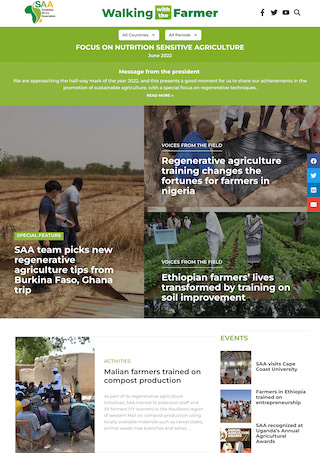
E-newsletter
"Walking with the Farmer"
SAA publishes a bimonthly e-newsletter reporting on SAA activities.
SAA Mail News
Sign up to receive our e-newsletter and upcoming event information via email.

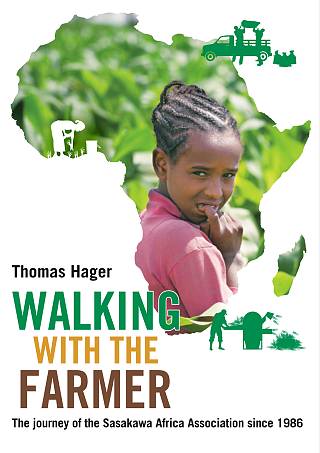
SAA history book
"Walking with the Farmer: The journey of the Sasakawa Africa Assoication since 1986"
This book chronicles the history of SAA from its inception to the present.
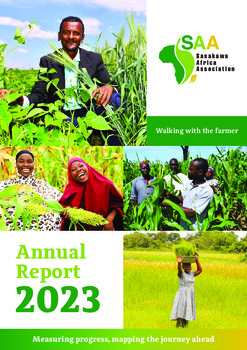
Annual Report
Annual Report FY2023
Annual Report FY2023 is available here.


