SAA Uganda and Napak District Launch Innovative School Feeding Model to Improve Nutrition, Learning, and Livelihoods in Karamoja
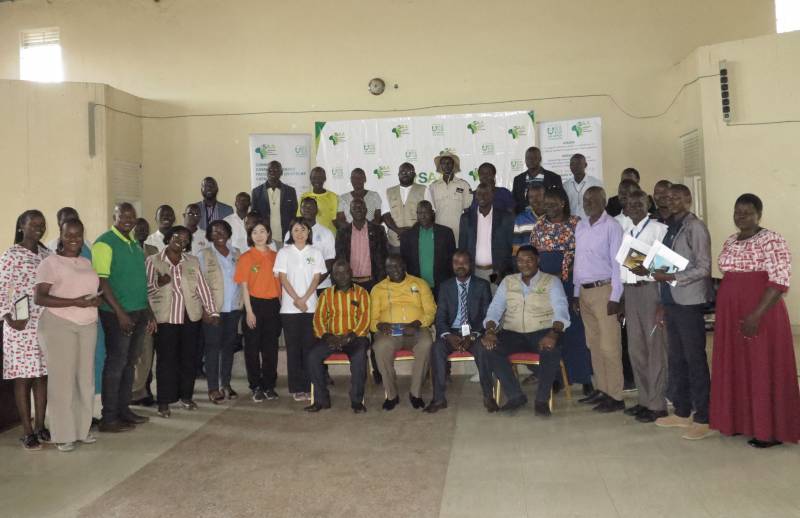
Schools in Napak District are being transformed into platforms for learning, nutrition, and local economic development through an innovative school feeding initiative launched by Sasakawa Africa Association (SAA) Uganda in partnership with The Nippon Foundation and Napak District Government. The five-year programme aims to improve educational outcomes while strengthening local food systems, supporting smallholder farmers, and building resilient communities across northeastern Uganda.
The initiative was introduced during an inception meeting that brought together government officials, development partners, community leaders, and education stakeholders, demonstrating strong commitment at local, district, and national levels. The programme will benefit 6,000 pupils across five primary schools in Napak's Lokopo, Matany, and Lopeei sub-counties while engaging approximately 2,000 smallholder farmers in contract farming, climate-smart agriculture, and school-linked food production systems.
Schools as Platforms for Learning and Enterprise
While nutritious daily meals are a central component of the initiative, the programme is designed to deliver broader social and economic benefits. Schools will serve as centers for innovation, agricultural learning, entrepreneurship, and community development.
SAA Uganda Country Director Robert Anyang described schools in these communities not as recipients of aid but as platforms for transformation. “Schools will turn into centers of innovation, learning, and enterprise,” he said.
At Nakichelet Primary School, mushroom production is already integrated into learning activities. Pupils gain practical agribusiness skills while teachers and parents replicate the model at household level. SAA is also collaborating with Uganda’s National Agricultural Research Organization (NARO) to establish seed production hubs at selected schools, producing certified seed for local markets.
Strengthening Local Food Systems
A key feature of the programme is its emphasis on linking schools directly with local food producers. The initiative promotes contract farming arrangements, climate-smart agriculture, school gardens, and improved food production systems that connect farmers to reliable local markets.
Abelle Joseph, Liaison Officer for School Feeding at the Ministry of Education and Sports, emphasized the importance of local procurement. “Home, for many children in Karamoja, is school, where they are able to enjoy food through school feeding programs,” he said.
Uganda is currently developing a national School Feeding Policy, while safety standards and national school menus have already been drafted. Abelle invited SAA Uganda to join the National Technical School Feeding Committee, highlighting the strategic importance of the partnership in shaping future school feeding systems in the country.
The Napak initiative also builds on lessons and experiences from earlier school feeding interventions in Karamoja, including those supported by the World Food Programme (WFP). These experiences have informed the design of the model, particularly in promoting local food procurement, community ownership, and sustainable school feeding systems. SAA Uganda also continues to collaborate with WFP in implementing a larger school feeding programme across 40 schools in Karamoja, where similar approaches and lessons will be scaled and adapted to reach more communities.
The programme will also engage local millers and processors, create additional economic opportunities while ensuring that food production and consumption remain anchored within the local economy.
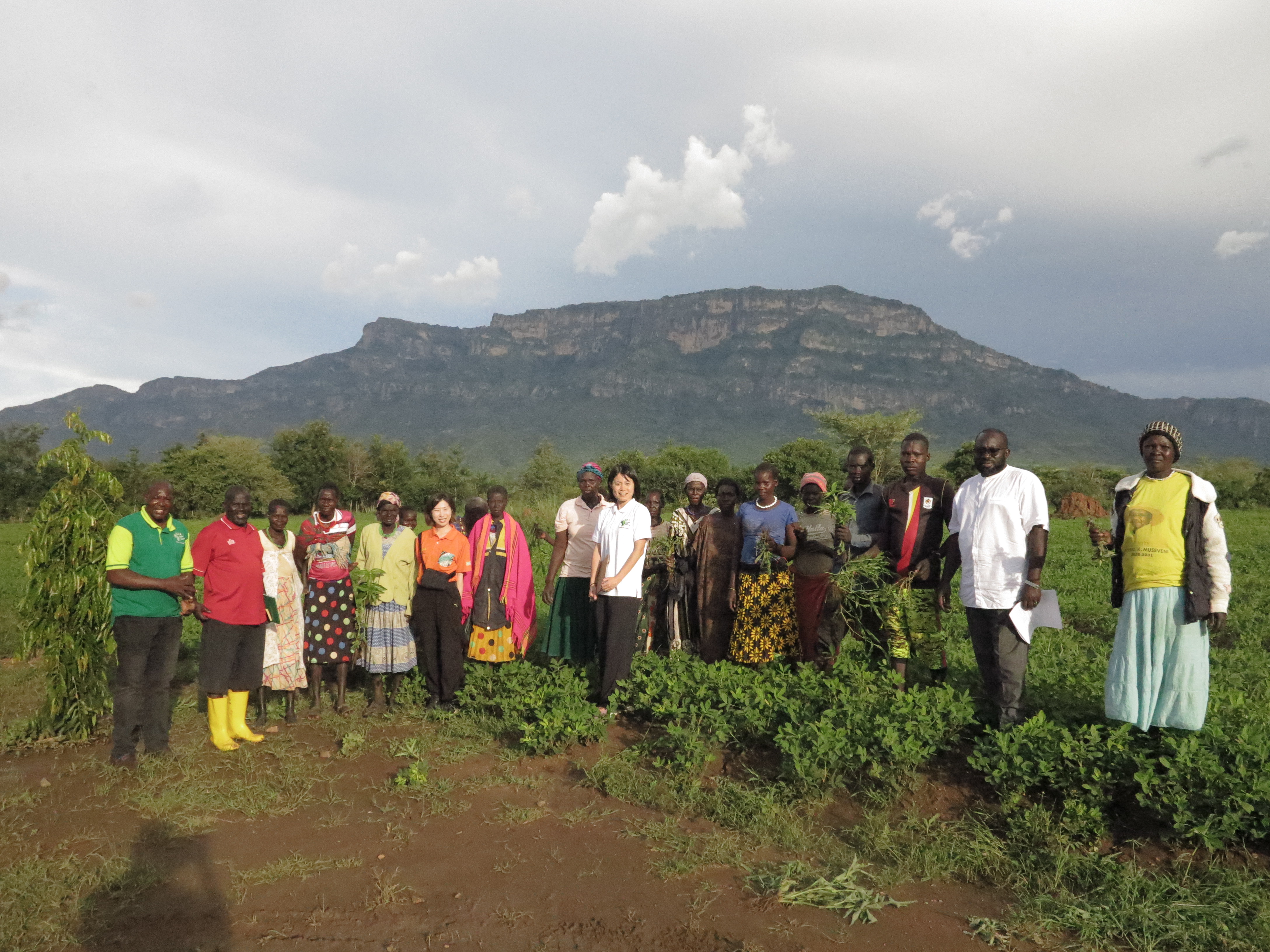
SAA team visiting some of the farming fields in Napak District
Improving Nutrition, Attendance, and Child Wellbeing
The initiative comes at a critical time for Napak District, where school attendance and retention remain major challenges. Napak Chief Administrative Officer Robert Abia Owili highlighted the strong relationship between school feeding, education, and child protection. The district currently faces significant challenges associated with vulnerable children and school absenteeism. “The connection between hunger and trafficking is not incidental. When children are hungry, they leave school. When they leave school, they become vulnerable,” Owili explained.
District LC5 Chairperson John Paul Kodet noted that more than 49 percent of Napak’s street children have already been integrated into schools through ongoing government and community efforts. “Education is the backbone of changing our society. We want to move Napak children’s identity from street beggars to school learners,” Kodet said.
The school feeding programme is expected to strengthen these efforts by improving attendance, retention, nutrition, and learning outcomes, particularly among vulnerable children.
Building Community Ownership and Resilience
The programme incorporates a range of interventions aimed at strengthening long-term resilience for both schools and farming households. In addition to food production activities, investments include water, sanitation, and hygiene infrastructure. In areas such as Nakichelet where water salinity presents challenges, reverse osmosis systems have been installed to improve water quality.
The programme’s Technical Coordinator, Jacqueline Namusalisi, emphasized the importance of maintaining food quality and safety throughout implementation. Particular attention is being given to preventing aflatoxin contamination in stored and processed foods to protect nutrition outcomes.
The initiative also tracks progress across three key areas: education, nutrition and health, and household and school resilience. Strengthening local ownership and sustainability is therefore increasingly important.
A Model for Local Economic Development in Karamoja
The programme reflects a broader vision for Karamoja's future, one that recognizes the region’s potential rather than focusing solely on its challenges. Representing the Resident District Commissioner, Deputy RDC (DRDC) Swadik Angupale encouraged participants to challenge outdated perceptions of the region.
“Government investment has positioned Karamoja sub-region as a hub for tourism and economic development. The region is a take-off place,” he said. He urged stakeholders to share the story of communities working together to create opportunities for children, farmers, and families through education and local economic development.
The strong commitment demonstrated by local leaders, national government representatives, development partners, and communities’ underscores the programme’s potential to become a model for sustainable school feeding and community transformation.
For the 6,000 children expected to benefit from the initiative—and for the thousands of families whose livelihoods are linked to local agriculture, the programme offers a pathway toward improved nutrition, better educational outcomes, stronger local food systems, and greater resilience across Karamoja.
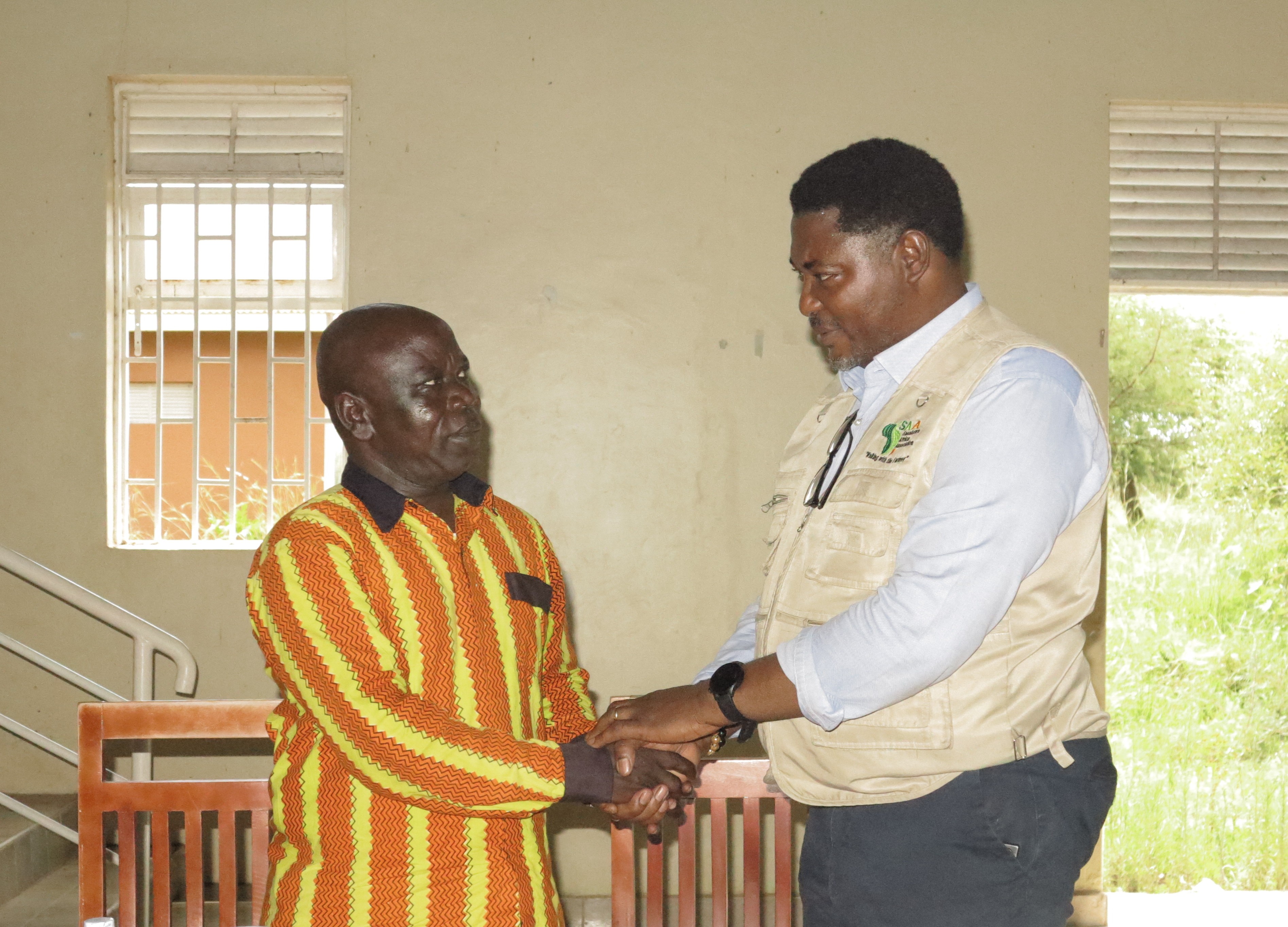
DRDC Mr. Swadik Angupale and SAA Uganda Country Director
SAA Publications
E-newsletter
"Walking with the Farmer"
SAA publishes a bimonthly e-newsletter reporting on SAA activities.
SAA Mail News
Sign up to receive our e-newsletter and upcoming event information via email.

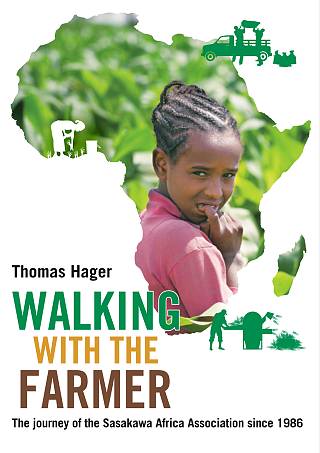
SAA history book
"Walking with the Farmer: The journey of the Sasakawa Africa Assoication since 1986"
This book chronicles the history of SAA from its inception to the present.
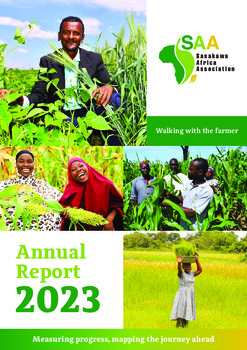
Annual Report
Annual Report FY2023
Annual Report FY2023 is available here.


