【Activity】The One Bag Initiative: Strengthening Farmer Cooperatives for Financial Resilience
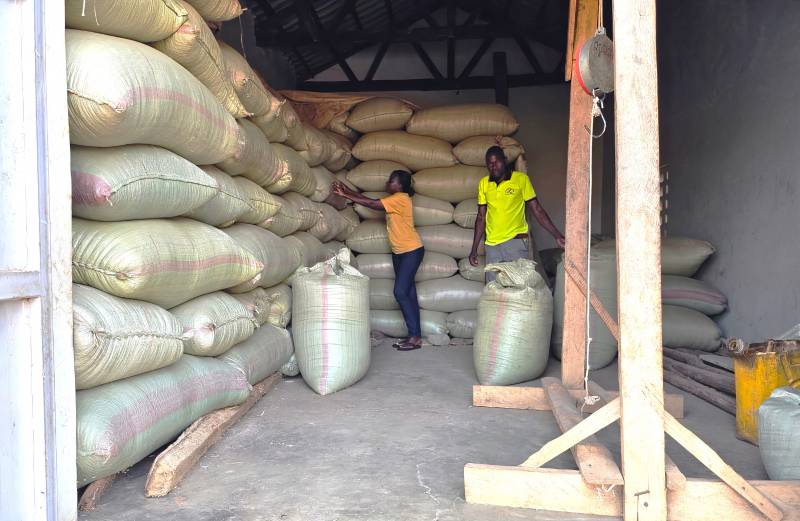
Sasakawa Africa Association (SAA) continues to develop innovative strategies to strengthen smallholder farmer cooperatives/One-Stop Center Associations (OSCAs) by addressing key challenges such as access to inputs, financing, and market opportunities. A key focus is on building local assets to make them bankable. One of SAA’s transformative initiatives, the One Bag Initiative (OBI), introduced through its Market-Oriented Agriculture program with support from the Nippon Foundation, has emerged as a game-changer in strengthening cooperatives, enhancing service delivery, and improving market access.
The One Bag Initiative (OBI) is a cooperative-based model designed to improve financial resilience, aggregation, and market linkages for smallholder farmers. The initiative is built on the principle of collective action, where each farmer voluntarily contributes one bag of produce per season to their cooperative. This pooled resource is reinvested to strengthen cooperative operations, allowing them to offer essential services such as credit facilities, mechanization, storage, and access to better markets.
Transitioning Smallholder Farmers to Commercial Agriculture
By implementing the OBI, SAA aims to help smallholder farmers transition from subsistence farming to commercially viable enterprises. The initiative aligns with SAA’s overarching goal of strengthening smallholder farmer cooperatives and OSCAs by enhancing their financial independence, bargaining power, and long-term sustainability. Through the OBI, cooperatives can reduce post-harvest losses, secure better prices through bulk marketing, and establish structured engagement with formal buyers.
Many smallholder farmer cooperatives struggle with limited working capital and irregular member contributions, which hinder their sustainability. OBI was introduced as a structured, participatory model to build resilience from within by ensuring member contributions and financial stability.
Implementation and Key Stakeholders
Cooperatives were selected for OBI implementation based on their existing operational capacity, governance structure, and willingness to pilot the model. Key stakeholders, including OSCA board members, Commercial Community-Based Facilitators (CCBFs), and District Commercial Officers (DCOs), played a crucial role in mobilizing cooperative members and sensitizing farmers to the benefits of OBI.
In December 2024, SAA conducted targeted training sessions in Mubende, Lira, Iganga, and Mbarara, bringing together 82 participants (62 men, 20 women). These training sessions equipped cooperative leaders with skills in OBI management, value chain integration, and business development. Using case studies, group discussions, and interactive presentations, participants explored practical ways to implement the OBI model. A key takeaway from the training was the importance of mobilizing farmers to contribute a single bag of produce per season, creating a shared resource pool to reinvest in cooperative operations. The training also addressed challenges such as low farmer participation, inadequate storage facilities, and weak market linkages, by introducing improved aggregation techniques, planned production strategies, and contractual agreements with buyers.
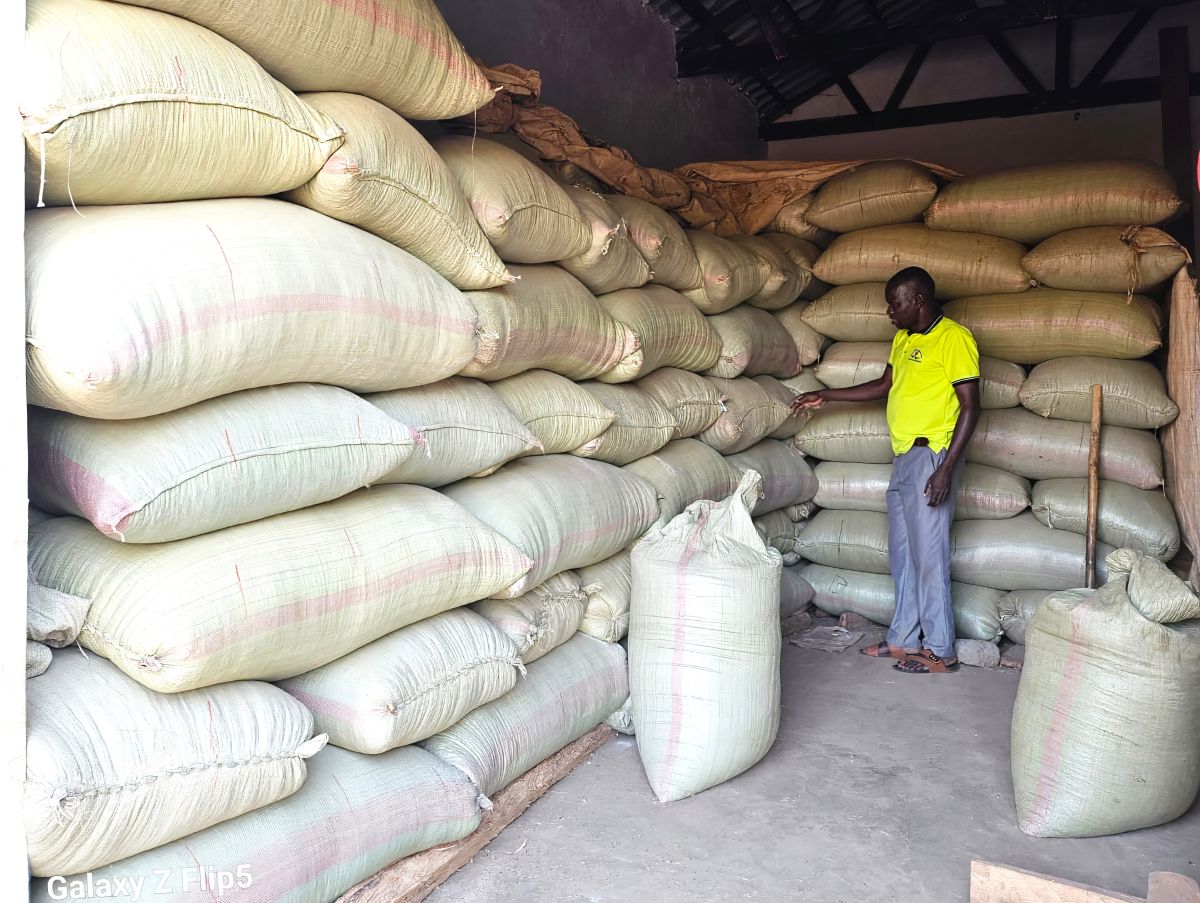 Storekeeper taking records of the bags
Success Story: Lelakot Cooperative’s Transformation
Lelakot Cooperative, once grappling with low member contributions and participation, financial constraints, and limited service provision, has undergone a remarkable transformation with the introduction of OBI. The cooperative bulked 30 tons of maize through collective storage and bulk selling. Lelakot farmers aim to significantly improve their bargaining power with formal buyers to achieve a 30% increase in their earnings in the coming months. This shift will not only enhance their financial stability but also revitalize the cooperative, fostering greater member engagement and long-term sustainability.
Additionally, farmers received training in quality standards and post-harvest management, resulting in a 40% reduction in post-harvest losses. By consistently supplying high-quality maize, the cooperative aims to attract large-scale buyers and secure better prices for its members. Looking ahead, Lelakot plans to expand its services, offering farmers access to quality inputs on credit, mechanization services, and improved storage facilities.
Scaling Up OBI for Long-Term Impact
OBI is a long-term strategy for strengthening farmer organizations. To ensure its sustainability, SAA is leveraging Commercial Community-Based Facilitators (CCBFs) to deliver services such as access to credit facilities, cost-reducing production technologies, and market linkages with formal buyers. These interventions are designed to help farmers transition from subsistence farming to commercial production.
SAA plans to scale up OBI across Uganda through the CCBF model by expanding training programs and fostering partnerships with agribusiness stakeholders. Strategies for enhancing cooperative resilience include diversifying income sources, strengthening governance structures, and linking cooperatives with financial institutions for long-term sustainability.
Beyond financial sustainability, the OBI training introduced contract farming, emphasizing its role in enhancing agricultural productivity. The response from farmers has been overwhelmingly positive: three contract agreements have been signed for sunflower production, and four maize contracts are under review. This brings confidence and trust between farmers and buyers.
Furthermore, the OBI is also fostering new partnerships with financial institutions and agribusiness stakeholders. Cooperatives that demonstrate financial discipline through OBI implementation will have a smooth pathway to access credit for investments in asset building, making them more bankable.
In conclusion, the One Bag Initiative is more than just an aggregation model — it is a catalyst for sustainable cooperative growth, financial independence, and improved livelihoods for smallholder farmers. OBI is positioning cooperatives as the backbone of rural economies by fostering a culture of collective action, trust, and structured engagement. As SAA continues to scale up the initiative, more farmers will have the opportunity to transition into commercial farming, contributing to food security and economic development in Uganda. Through strategic interventions, continuous training, mentorship, coaching, and stakeholder collaboration, OBI is paving the way for a more resilient and prosperous agricultural sector.
SAA Publications
E-newsletter
"Walking with the Farmer"
SAA publishes a bimonthly e-newsletter reporting on SAA activities.
SAA Mail News
Sign up to receive our e-newsletter and upcoming event information via email.

SAA history book
"Walking with the Farmer: The journey of the Sasakawa Africa Assoication since 1986"
This book chronicles the history of SAA from its inception to the present.
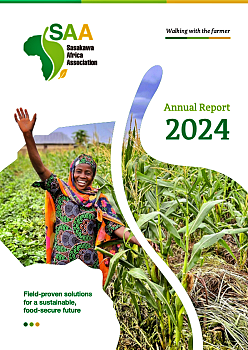
Annual Report
Annual Report FY2024
Annual Report FY2024 is available here.


