【Farmers' story】Solar-Powered Success: How a Ugandan Farmer Turned a Small Loan into a Climate-Resilient Legacy
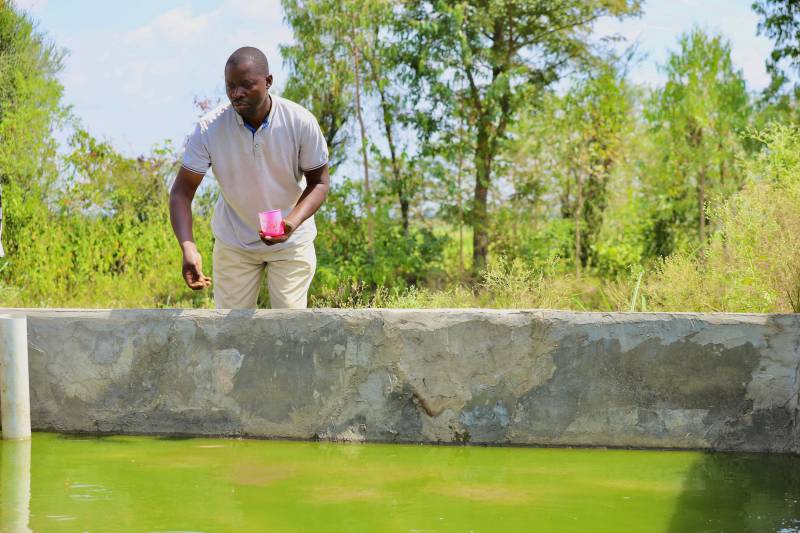
For years, Mulwani Moses farmed not to grow, but simply to survive. A 35-year-old father of three from Kibuku District, Moses depended entirely on rain-fed farming on five acres inherited from his late father. Each season brought the same uncertainty late rains, dry spells, declining soil fertility, and unstable yields. Despite his hard work, income remained unpredictable, and every shock pushed his family closer to vulnerability. Like many smallholders, Moses understood farming but not how to make it resilient or consistently profitable. “I worked the land every season,” he recalls, “but I never knew how much I would earn or whether it would be enough.”
A Shift in Mindset
Moseses’ journey began to change when he joined the Pallisa Agribusiness and Institutions Development Centre (PATA), a One Stop Centre Association (OSCA) supported by SAA with funding from The Nippon Foundation. Through regular training in regenerative agriculture, climate risk management, soil fertility improvement, and financial literacy, He began to see farming differently not as a gamble, but as a system that could be planned, diversified, and strengthened over time.
The most important shift was mental.
“Before, I farmed just to survive,” Moses explains. “Now I plan, I save, and I think about farming as a business.” Over five disciplined years, Moses saved USD 2,246, a significant achievement for a rain-fed farmer. But he knew savings alone would not be enough to overcome climate risk.
Taking a Calculated Risk
Growing up near the Mpologoma River in eastern Uganda, Moses had long admired fish farmers whose incomes were steadier and less dependent on rainfall. His envisioned combining irrigated horticulture with fish farming, but the startup costs were far beyond his reach. The breakthrough came in early 2025 through SAA’s Commercial Community Based Facilitator (CCBF) network, which linked Moses to Vision Fund Uganda, a microfinance institution offering agriculture-friendly loans repayable over twelve months. Backed by his savings and strengthened by training, Moses secured a loan of USD 842. It was a calculated risk, grounded in knowledge, planning, and growing confidence.
 |
 |
Investing in Climate-Smart Solutions
With combined capital from savings and credit, Moses invested in a solar-powered irrigation system, accessed at a significantly reduced cost through SAA-facilitated partnerships. For the first time, water was no longer his biggest constraint. Irrigation unlocked immediate returns: USD 505 from tomatoes and USD 281 from onions, income he deliberately reinvested into expanding his enterprise.
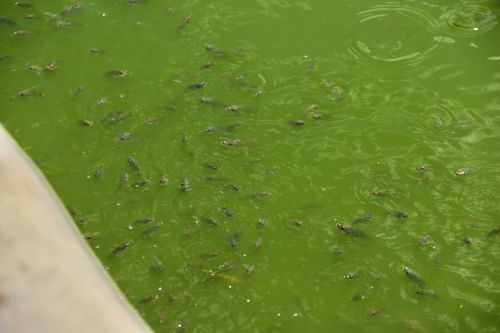
He used those proceeds to construct two fishponds, stocking them with quality fingerlings. Instead of operating separate enterprises, Moses adopted an integrated farming system: nutrient-rich pond water irrigates crops, reducing fertilizer costs while improving yields, and crop residues support fish production. “Nothing on my farm goes to waste now,” he says. “The fish support the crops, and the crops support the fish.”
From Vulnerability to Stability
By the end of 2025, Moses harvested market-ready catfish weighing about one kilogram each, earning USD 1,371 from catfish sales. This income transformed his household economy. School fees are now paid on time. Food security has improved. Seasonal shocks no longer threaten his family’s survival.
Creating Community Impact
Moses now employs community members for pond construction, feeding, harvesting, and marketing. His fish supply affordable, high-quality protein to nearby households, contributing to improved nutrition for children and pregnant women. What began as a personal investment has multiplied into community-level benefit.
A Model for Resilient Agripreneurship
Moses’ story shows what happens when training, savings, finance, and climate-smart technology are deliberately linked. The loan did not trap him in debt, it unlocked productivity, diversification, and sustained income. As Moses proudly puts it:
“Sasakawa did not just teach me how to farm. They showed me how to build a future.” This is the power of SAA’s One Stop Centre model transforming smallholder farmers from climate-exposed producers into resilient agripreneurs, capable of generating income, managing risk, and creating opportunity for others.

Moses’ larger fishpond during a field visit by SAA staff.
SAA Publications
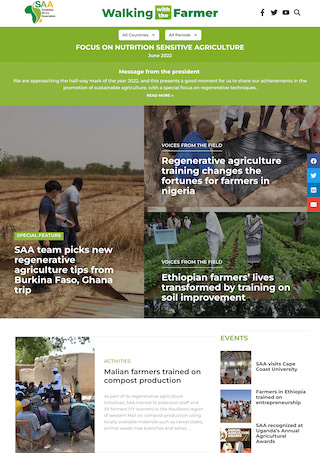
E-newsletter
"Walking with the Farmer"
SAA publishes a bimonthly e-newsletter reporting on SAA activities.
SAA Mail News
Sign up to receive our e-newsletter and upcoming event information via email.

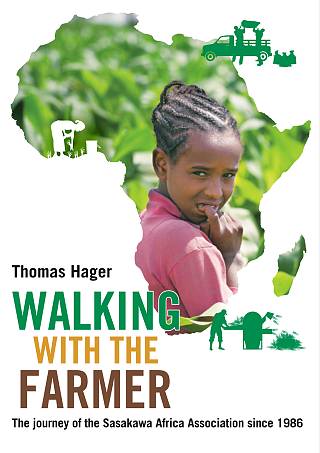
SAA history book
"Walking with the Farmer: The journey of the Sasakawa Africa Assoication since 1986"
This book chronicles the history of SAA from its inception to the present.
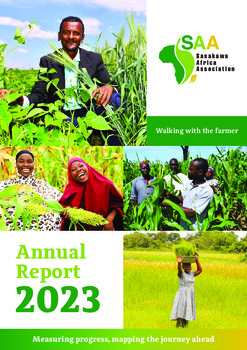
Annual Report
Annual Report FY2023
Annual Report FY2023 is available here.


