【Activity】Climate-Smart Rice Farming in Benin: Regenerative Practices Double Yields and Reduce Emissions
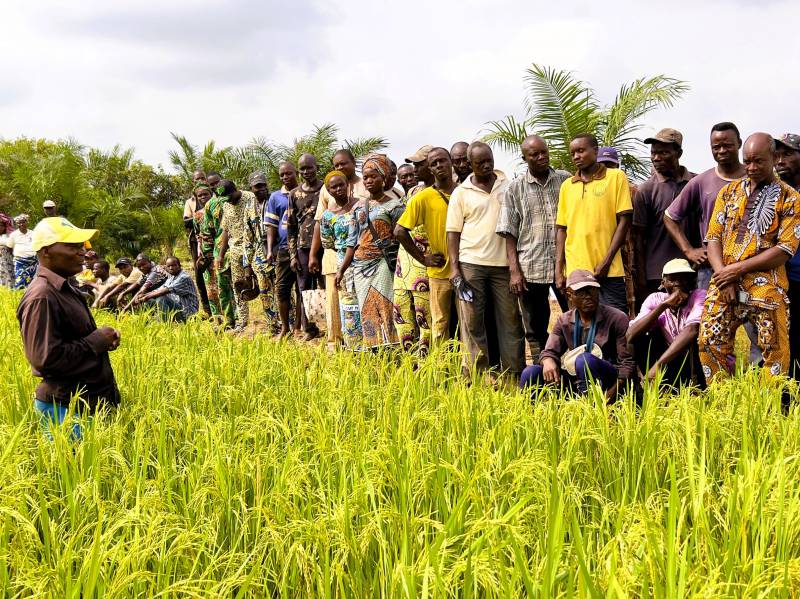
Rice farmers in key production zones of the Benin Republic are experiencing a significant productivity transformation following the adoption of climate-smart and regenerative agricultural practices. In sevfral intervention communites, yelds have more than doubled, while water efficiency and soil health have improved, contributing to lower greenhouse gas emissions from irrigated rice systems.
From January 13-16th, 2026, a joint technical team from the Sasakawa Africa Association (SAA) and IITA/TAAT visited the intervention communities in Koussin-Lélé, Tangbédji, Agoïta, and Tchi-Ahomandégbé, located within the districts of Covè, Zogbodomè, and Lalo. The mission included farmers’ field days and a technical assessment of the results fom the 2025 off-season farming cycle. The activities are implemented under the “Improving Rice Productivity by Decarbonizing Cultivation for 12,000 Hectares of Irrigated Paddy Fields in the Republic of Benin project”, funded by the African Development Bank (AfDB) through the Japan Policy and Human Resource Development Grant (PHRDG).
Regenerative and Decarbonized Rice Production
The SAA Nigeria team evaluated the performance of a comprehensive agronomic package deployed to improve soil health, water efficiency while mitigating climate risks in the region. Key innobations introduced include: precision line transplanting at 14 days (replacing tradional broadcasting), certified high-performing rice varieties FARO 67¹ and ORYLUX 6². To support these improved varieties, the project introduced soil regeneration techniques including the production and application of biochar and urea super granules (USG), alongside Alternate Wetting and Drying (AWD) methods to conserve water resources. These integrated practices represent a shift toward regenerative, carbon-smart rice cultivation systems.
Yield Gains More Than Double
The results revealed a striking contrast between traditional practices and the improved package. In Tangbédji community, farmers reported that the introduced technologies generated yields of 500 kg per 1,000 m² (0.1ha), an impressive leap from the 200 kg per 1,000 m² (0.1ha under traditional practices. This represents more than a twofold increase in productivity. Similar gains were observed in Agoïta Koussin Lele, and Tchi-Ahomandégbé, where adoption is expanding steadily. Mr. Monssin Barnabé, an early adopter who applied the technology package on one hectare, harvested 4.885 tons of paddy rice. Encouraged by the results, he has committed to expanding his cultivation area to three hectares in the upcoming season.
Scaling Decarbonized Rice Systems in Benin
Beyond yield improvements, farmers expressed high receptivity to the new practices, specifically citing reduced seed rates, improved soil health, and visible income growth as major drivers for their willingness to adopt the full package. Farmers noted that the new varieties not only offered shorter growth cycles, but also superior aroma and taste compared to the traditional IR841³ variety.
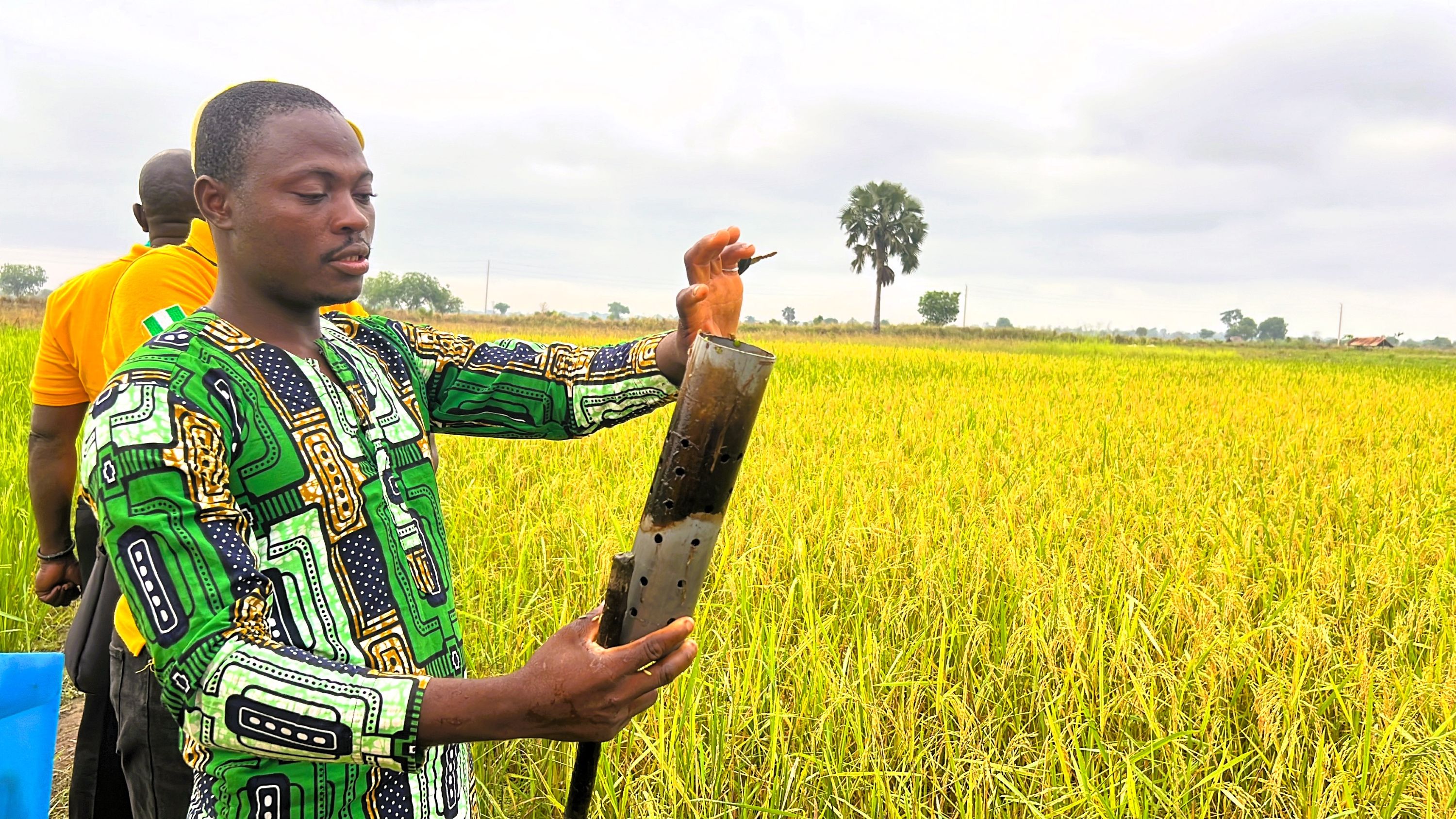 A lead farmer Mr. Dohoue applies water only when needed using SAA’s Alternate Wetting and Drying technology to reducing water waste, preventing crop loss, and lowering methane emissions.
However, the rapid increase in production has highlighted "second-generation" challenges characteristic of successful agricultural interventions. The team identified a critical lack of reliable off-takers, resulting in significant stockpiles of paddy rice in local warehouses, ultimately affecting income. To sustain these productivity gains, farmers made an urgent appeal for mechanization support specifically mechanical harvesters and urea briquette machines and applicators to lower production costs and reduce the labor burden associated with larger harvests. Furthermore, infrastructure remains a bottleneck in Tangbédji, where broken boreholes currently limit dry-season irrigation to just 30 ha, leaving a potential 510 ha uncultivated during the off-season.
As the project enters its final phase, addressing these market linkage and mechanization gaps will be essential to ensuring that these bumper harvests achieved through decarbonized cultivation with minimal effects on the environment translate into sustainable economic prosperity for Benin's farming communities.
Notes:
¹ FARO 67: An improved, high-yielding rice variety released by the National Cereals Research Institute (NCRI), Nigeria. It is known for good grain quality, adaptability to lowland ecologies, and relatively short maturity duration.
² ORYLUX 6: An improved certified rice variety recognized for its high yield potential, climate resilience, and adaptability to irrigated and lowland production systems.
³IR841: A widely cultivated improved lowland rice variety introduced in Nigeria through AfricaRice breeding programs. It is valued for its high yield potential and adaptability to irrigated and rainfed lowland ecologies but is often considered to have average grain aroma and taste compared to newer premium varieties.
SAA Publications
E-newsletter
"Walking with the Farmer"
SAA publishes a bimonthly e-newsletter reporting on SAA activities.
SAA Mail News
Sign up to receive our e-newsletter and upcoming event information via email.

SAA history book
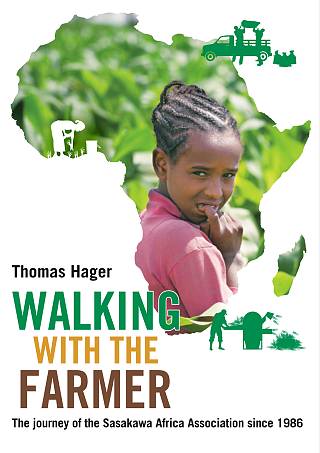
"Walking with the Farmer: The journey of the Sasakawa Africa Assoication since 1986"
This book chronicles the history of SAA from its inception to the present.
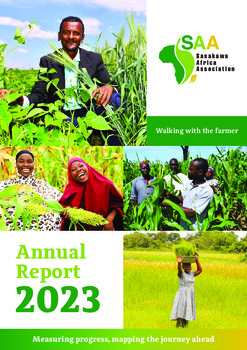
Annual Report
Annual Report FY2023
Annual Report FY2023 is available here.


