【Farmers' story】Women Leading Agricultural Innovation in Ethiopia: Meryema Aba Sura’s Soybean Success Story

Overcoming Declining Yields
Ms. Meryema Aba Sura is a 45-year-old widow and mother of four living in Decha Nedhi Kebele, Nedhi Gibe District, Jimma Zone, Oromia Region. Her experience highlights the critical shift from traditional monocropping to the maize-soybean rotation that is central to this project. Farming is her main livelihood, and for years she relied primarily on maize production for household consumption. “My life depends on farming, especially maize, which I mainly grow to feed family”, she explains.
Eight years ago, Meryema began soybean production after receiving training from the Jimma Agricultural Research Center on its agronomic and nutritional benefits. However, limited market access meant her production remained small, between 100 and 150 kg per year, mainly for household consumptions. Like many farmers in the area, she relied on home-saved seeds from old soybean varieties that had been introduced into the system many years ago. Over time, productivity declined. Farmers in her community also faced declining maize yields due to continuous monocropping and worsening soil acidity.
The SoyLink Partnership Brings New Opportunities
A turning point came in 2024, when AGRA-supported initiative to strengthen the soybean value chain were launched through the SoyLink Partnership involving the Sasakawa Africa Association (SAA), Green Agro Solution (GAS), and Farm Radio International (FRI). Under this collaboration: SAA introduced regenerative farming practices, including maize-soybean rotation, improved access to climate smart soybean varieties, lime application, conservation agriculture, and Food Loss Reduction Solutions (FL-RS). FRI strengthened farmer outreach through radio-based extension service while GAS facilitated input financing and market access. Together, these efforts aimed to strengthen soybean production, improve soil health, and enhance farmers’ incomes.
Breaking Norms and Expanding Production
“My fellow farmers and I were organized into a cluster group by SAA, and I was nominated as a Deputy Chairperson,” Ms. Meryema says. Through the project, farmers were organized into cluster groups to improve access to input, advisory services, finance and markets. The clustered farming approach strengthened peer learning and improved farmers’ market orientation. Ms. Meryem and her fellow farmers adopted an improved soybean variety known as SCS-1, replacing the older variety they previously relied on. Encouraged by improved market access, she expanded her soybean cultivation during the 2025 main cropping season to 0.375 ha, 0.25 ha on her own land and an additional 0.125 ha through a share cropping arrangement with another farmer.
In rural Ethiopia, widows often rent out or sharecrop their land due to labor shortages and economic constraints. Ms. Meryema has defied this norm. Instead of leasing out her land, she expands her production by renting additional plots from other farmers. “I also mentor fellow women farmers in my community, and my farm has become a model that people even traveled from distant villages to visit,” she underlined.
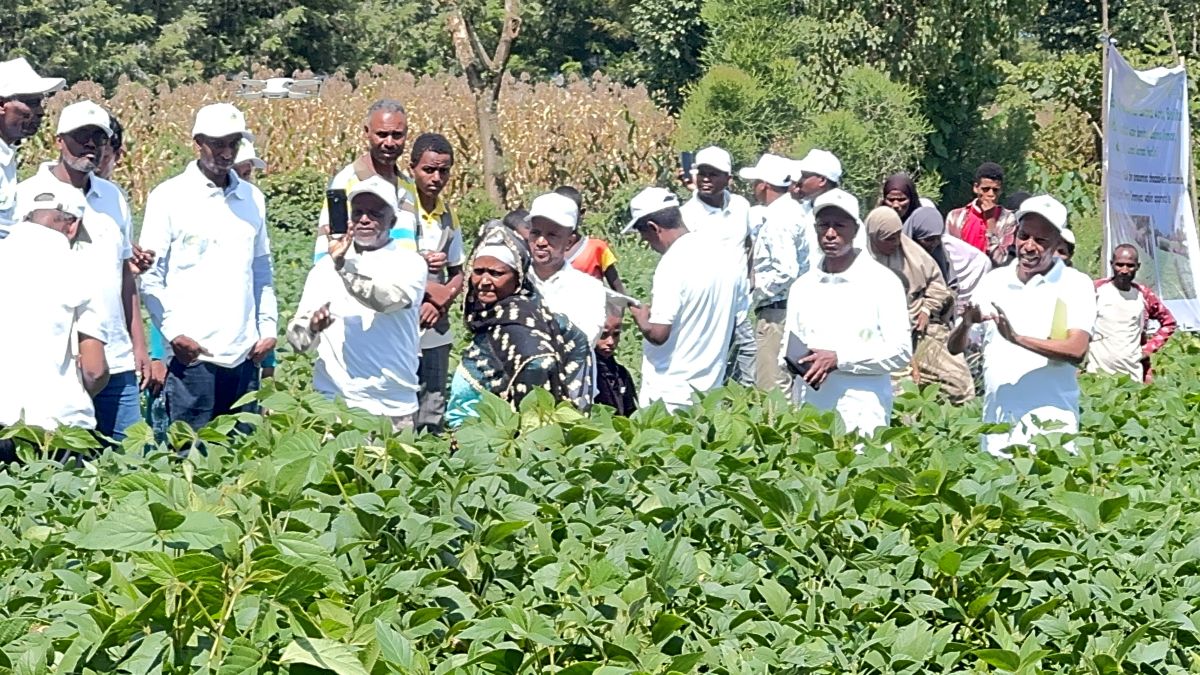 Ms. Meryema introduces her soybean farm to participants at a regional field day
Higher Yields and Improved Livelihoods
Ms. Meryema harvested 2.94 tons/ha, exceeding the kebele average of 2.72 tones/ha. Based on prevailing market prices, her harvest is expected to generate between USD 1,368 and 1,766 incomes. This remarkable productivity was achieved through the use of improved climate-smart varieties, the application of lime and rhizobium inoculants, and the proper implementation of other recommended improved agronomic practices such as minimum tillage, row planting, and the use of starter phosphorus fertilizers, among others.
Soybeans have also improved her family’s nutrition. She prepares a wide range of soybean-based foods, including milk, sauces, yogurt, cheese, bread, injera (flatbread), porridge, and a local non-alcoholic drink known as Karibo. “I even blend soybean with coffee on a two-to-one ratio,” she adds. Now we eat at least two soybean-based dishes every day.
Looking ahead, she is confident that the maize drop planted after soybean will double its productivity due to improved soil health and fertility.
Inspiring Other Women Farmers
Today, Ms. Meryema is leading her cluster group toward a new opportunity: soybean seed production, which will further diversify their income and strengthen local seed systems.
Her journey reflects the growing role of women farmers in driving agricultural innovation and regenerative and market-led farming practices in Ethiopia. By adopting improved technologies, mentoring fellow farmers, and expanding her production against traditional expectations, Ms. Meryema is providing that women farmers are not only participants in agricultural transformation, but they are also leaders shaping its future.
SAA Publications
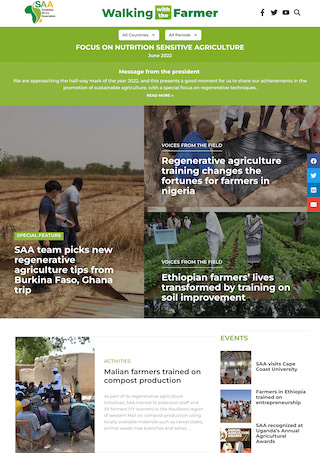
E-newsletter
"Walking with the Farmer"
SAA publishes a bimonthly e-newsletter reporting on SAA activities.
SAA Mail News
Sign up to receive our e-newsletter and upcoming event information via email.

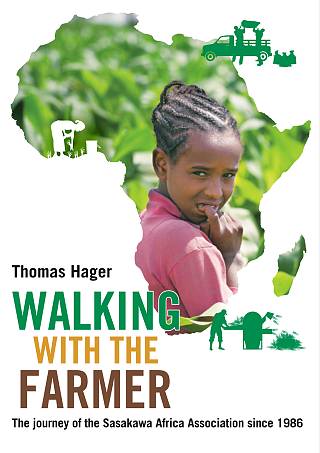
SAA history book
"Walking with the Farmer: The journey of the Sasakawa Africa Assoication since 1986"
This book chronicles the history of SAA from its inception to the present.
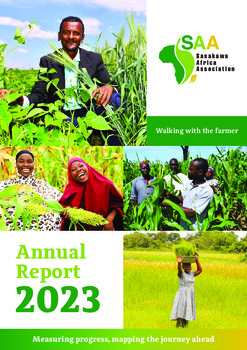
Annual Report
Annual Report FY2023
Annual Report FY2023 is available here.


