【Farmers' story】Regenerative Agriculture in Nigeria: How Climate-Smart Farming Doubled Yusuf’s Rice Yield
A Struggle with Traditional Methods
Mr. Yusuf Ijeh Ekom, a 43-year-old rice farmer, from Alagye community in Doma Local Government Area of NNasarawa State, Nigeria,is inspiring change across his community. Through training, determination, and timely support, he has transformed not only his farm but also his livelihood.
Alagye, is one of the communities where Sasakawa Africa Association (SAA) Nigeria has been implementing the “Evidence-Based Regenerative Agriculture to Address Climate Change in Africa Project”, project since 2022. Funded by the African Development Bank (AfDB) through the Japan Policy and Human Resource Development Grant (PHRDG), the project supports farmers with climate-smart agricultural practices that improve productivity and resilience.
Before joining the project, Yusuf’s relied on conventional rice farming practices. He broadcast 150kg of rice seed over his 1.5-ha plot, hoping for a good harvest. But year after year, the returns were disappointing. His harvest rarely exceeded 18 to 20 bags (about 2 tons), bearly enough to feed his family or break free from debt.
“I used to take rice seed loans from Bade Kaka” Yusuf recalls. “By the time I repaid with my harvest, there was hardly anything left for my family. We barely survived.”
Adopting Regenerative Practices and Doubling Yields
Everything changed when Yusuf participated in SAA’s hands-on training on evidence based regenerative agriculture. He learned improved rice production techniques such as establishing nursery beds, transplanting seedlings with proper spacing, and using less seed more efficiently. Instead of broadcasting 150kg of seed, he knows plants only 50kg, while achieving significantly higher yields.
The transformation was dramatic.
“From the same 1.5 ha, I now harvest between 50 and 60 bags (about 5 to 6 tons),” Yusuf says proudly. “In 2023 alone, I harvested 55 bags during the dry season and 60 in the rainy season, a total of 110 bags in one year.”
Another breakthrough came when Yusuf learned to produce and apply Biochar, a natural soil amendment that boosts soil fertility and moisture retention. This regenerative practice helped his crops remain healthy even during dry spells.
New Income Streams and Improved Quality of Life
Before SAA's intervention, dry season farming was not an option for Yusuf. Those months were often idle and stressful., spent at home under a tree with little to do and frequent arguments with his wife. But now, things are different.
“Dry season farming has changed everything. I’m too busy to sit idle; my income has doubled, and my home is much more peaceful. My wife is happy too,” he says with a smile.
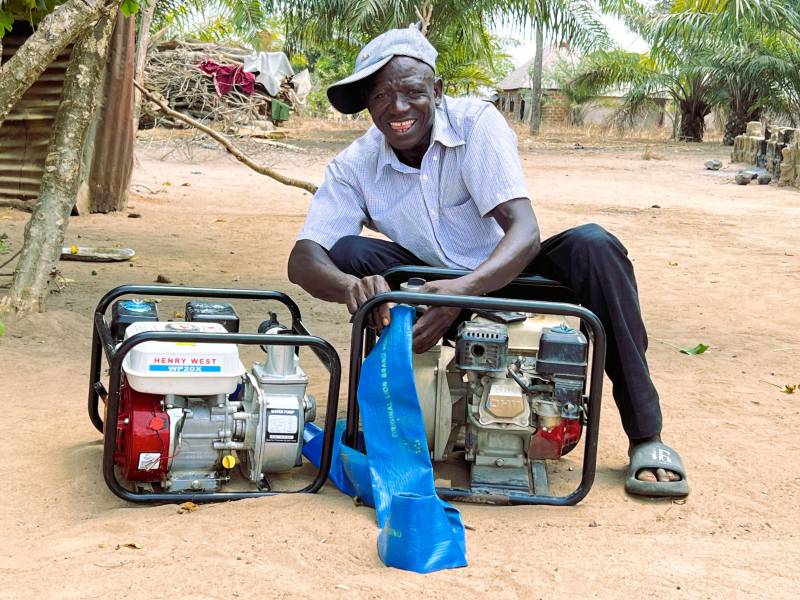
With the increased income from his rice harvests, Yusuf began to invest. He bought a 100-by-100-foot plot of land in Keffi, a growing urban center in Nasarawa state for NGN620,000 (about USD419). He has also started buying building materials to renovate his house. In addition, he purchased two water pumping machines, which he rents out to other farmers for NGN3,000 (about USD 2) per day, creating an additional source of income.
“I bought the second machine at the rate of NGN45,000 (about USD29) from the money I made renting out the first one,” he explains.
Transitioning to Climate-Smart Seeds
Yusuf has also ventured into seed production, switching from the older Faro 44 to the improved, climate smart Faro 66 variety, which produces higher yields and better grain quality. Demand for his seed has grown rapidly.
“People come to my farm, see the results, and buy seeds from me,” he says. “I sell a basin for NGN30,000 (about USD 21). With that money, I cleared my debts, bought land, and I’m planning to move my family to Keffi, where schools and security are better.”
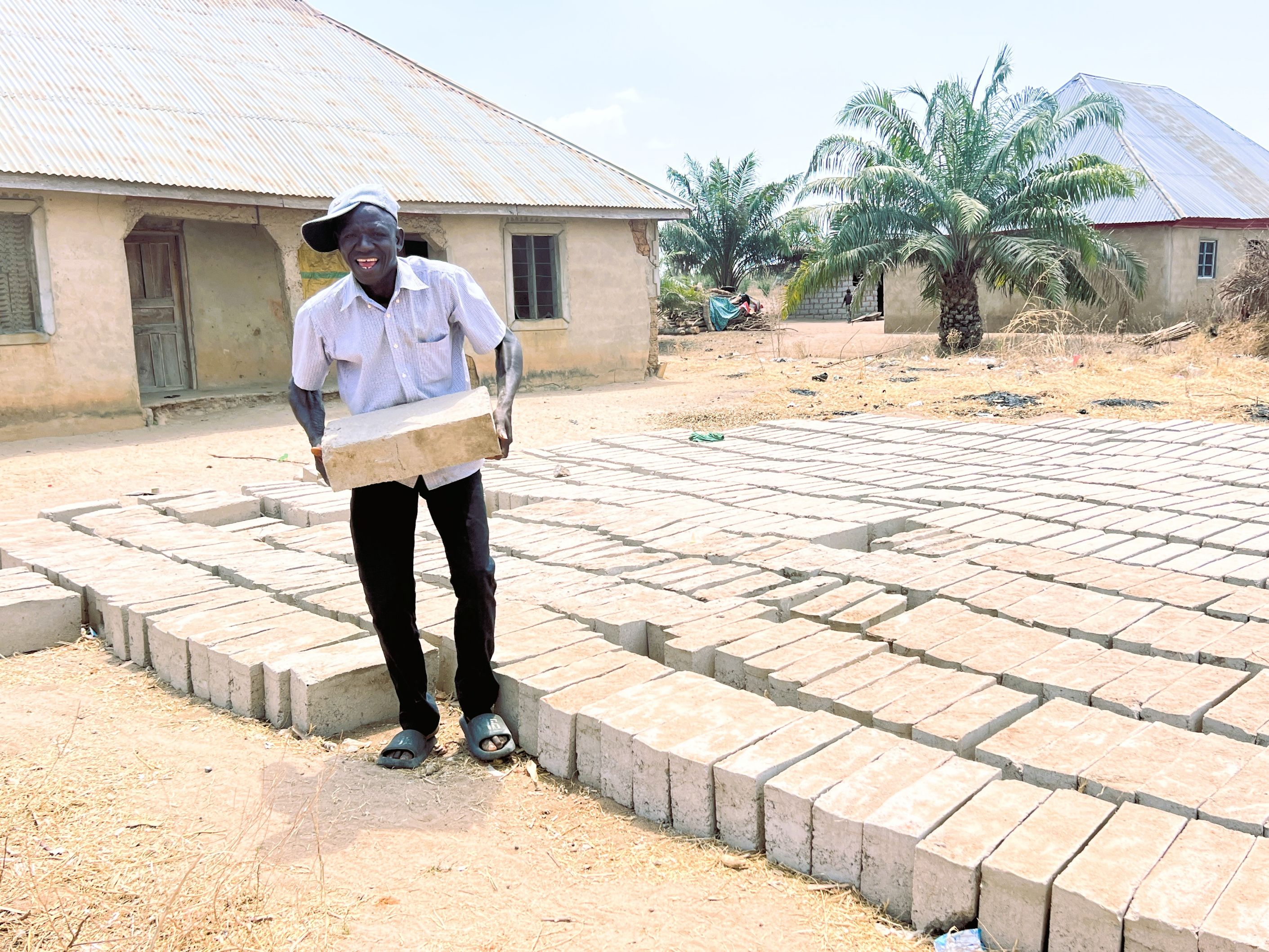 Mr Yusuf Ijeh is using proceeds from his rice farm to expand his home.
Inspiring Change in the Community
Yusuf’s story has inspired many farmers in Alagye. Neighbors who once followed traditional practices have begun to adopt improved methods, such as nursery establishment, transplanting, and applying Good Agronomic Practices (GAPs) promoted by SAA.
The Power of Partnership and Innovation
“Sasakawa didn’t just show me how to improve my farming,” Yusuf says. “They helped me change my life. I farm in both rainy and dry seasons now. I earn more, my children eat well, and my wife sleeps peacefully. I thank Sasakawa every day.”
Funded by the African Development Bank through the Japan PHRDG, the Evidence-Based Regenerative Agriculture Project promotes sustainable, climate-resilient farming in Nigeria. Implemented by SAA, SoftBank Corp, and IITA (International Institute of Tropical Agriculture)/TAAT (Technologies for African Agricultural Transformation) via the Nasarawa State ADP (Agriculture Development Program), it leverages scientific analysis and AI-powered technology to validate regenerative benefits.
The project aims to boost productivity, reduce emissions, and scale climate-adapted crop varieties. reaching 5,000 direct and 100,000 indirect beneficiaries, while targeting 40–60% productivity gains and a 30% improvement in farmer livelihoods.
- Bade Kaka: A local agricultural financing scheme that provides farmers with cash or input support at the start of the season, repayable in produce at harvest.
- FARO 44: An improved rice variety released by the National Cereals Research Institute (NCRI), Nigeria, widely cultivated for its high yield potential and adaptability to irrigated and lowland ecologies.
- FARO 66: An improved, climate-resilient rice variety released by NCRI, Nigeria, known for its high yield potential, improved grain quality, and tolerance to environmental stresses in lowland production systems.
SAA Publications
E-newsletter
"Walking with the Farmer"
SAA publishes a bimonthly e-newsletter reporting on SAA activities.
SAA Mail News
Sign up to receive our e-newsletter and upcoming event information via email.

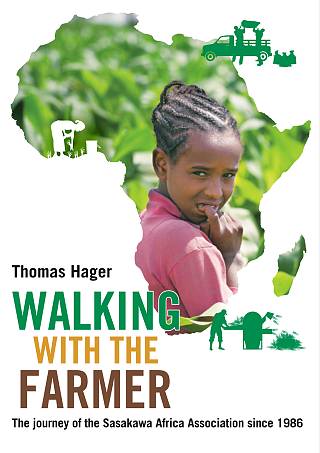
SAA history book
"Walking with the Farmer: The journey of the Sasakawa Africa Assoication since 1986"
This book chronicles the history of SAA from its inception to the present.
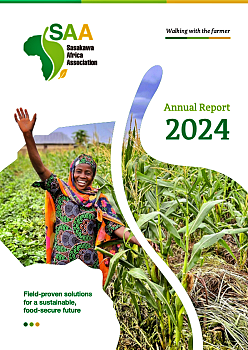
Annual Report
Annual Report FY2024
Annual Report FY2024 is available here.


